

New Consumer Guide Clarifies Technical Specifications for Emerging Portable Power Station Market
Demystifying the Glossary: Translating Wh, W, and LiFePO4 into Layman's Terms
To build a strong foundation, beginners must first master basic energy metrics that dictate real-world equipment performance. The most common point of confusion involves the relationship between Watt-hours (Wh) and Watts (W). To understand this easily, consumers can visualize a standard fuel tank where Watt-hours measure the total volume of fuel inside the reservoir. Conversely, Watts indicate the speed of the vehicle or how much electrical power the device can deliver at any single moment. Specifically, a unit with a higher wattage rating handles more demanding appliances, while a higher watt-hour rating determines how long those appliances can run before depletion.
Beyond basic power capacity, the underlying battery cell chemistry heavily influences safety, weight, and operational longevity. Legacy consumer electronics frequently utilized traditional lithium-ion formulations, which offer lightweight profiles but suffer from rapid performance degradation. In contrast, modern industrial standards lean heavily toward Lithium Iron Phosphate chemistry, commonly known as LiFePO4. The crystalline structure of LiFePO4 provides exceptional thermal stability and prevents hazardous overheating under heavy load conditions. Finally, an integrated pure sine wave inverter ensures that the outgoing alternating current mimics the clean, smooth wave delivery of a traditional household electrical grid, protecting sensitive microprocessors from electrical noise.
The Three Major Blind Spots: Deconstructing Beginner Procurement Pitfalls
First-time buyers regularly fall victim to predictable purchasing errors due to a superficial understanding of hardware specifications. The primary blind spot involves miscalculating the difference between running wattage and starting surge wattage. Many motorized appliances, including portable fans, small refrigerators, or water pumps, require a temporary power spike to activate their internal motors. If a consumer only looks at the continuous running wattage stated on the appliance label, they might select an underpowered generator that fails to handle that initial kinetic surge.
The second blind spot revolves around mistaking calendar longevity for dynamic cycle lifespan. Newcomers often assume that a power backup system will remain operational for a decade simply sitting in a closet. However, lower-grade batteries degrade steadily through internal chemical degradation regardless of actual usage frequency. Examining the certified cycle count reveals the true economic value of the system, as standard cells degrade after 500 cycles whereas premium variations maintain performance for thousands of charges.
Lastly, beginners frequently fall into the form-factor fallacy by prioritizing a hyper-compact exterior frame above all other metrics. While minimal weight enhances initial carry comfort, stripping away structural density can compromise necessary impact defenses and remove vital output ports. A balanced configuration provides sufficient surface area for adequate heat dissipation while maintaining structural integrity during real-world drops on rough terrain.
Eliminating Guesswork: The Visually Intuitive Dashboard of GEYOTO N300
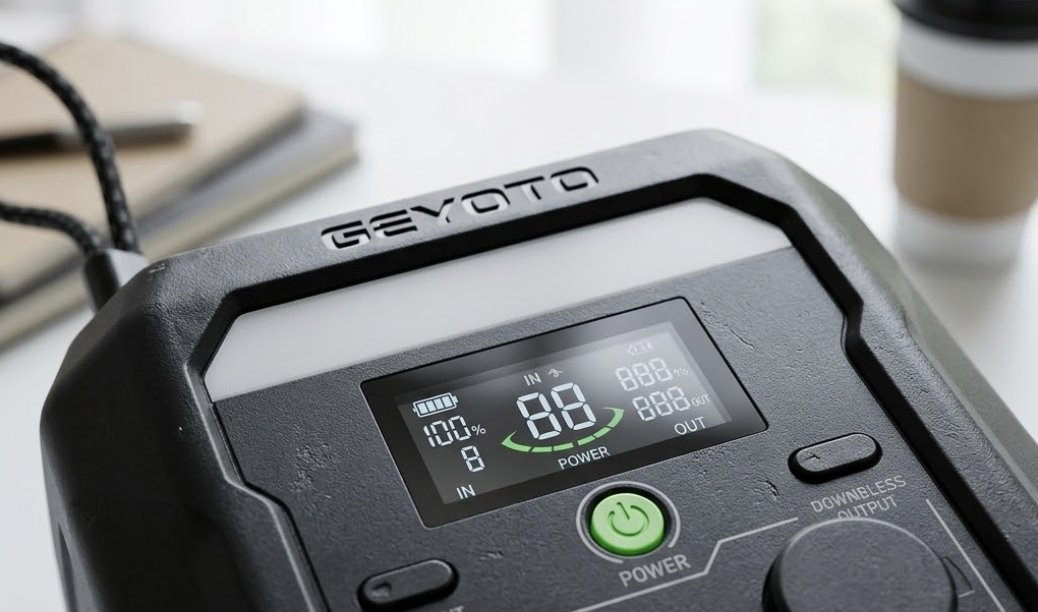
Navigating these technical complexities requires an interface that bridges the gap between sophisticated engineering and everyday consumer handling. The GEYOTO N300 addresses this operational challenge directly by offering a highly intuitive user experience that removes guesswork entirely. Engineers designed this system with a clear, dynamic LCD screen that serves as a real-time energy dashboard. The display provides instant visibility into precise input and output metrics, remaining battery percentages, and exact operational runtimes. This clear layout ensures that even complete novices can monitor their power consumption accurately without deciphering complex blinking LED lights or cryptic error codes.
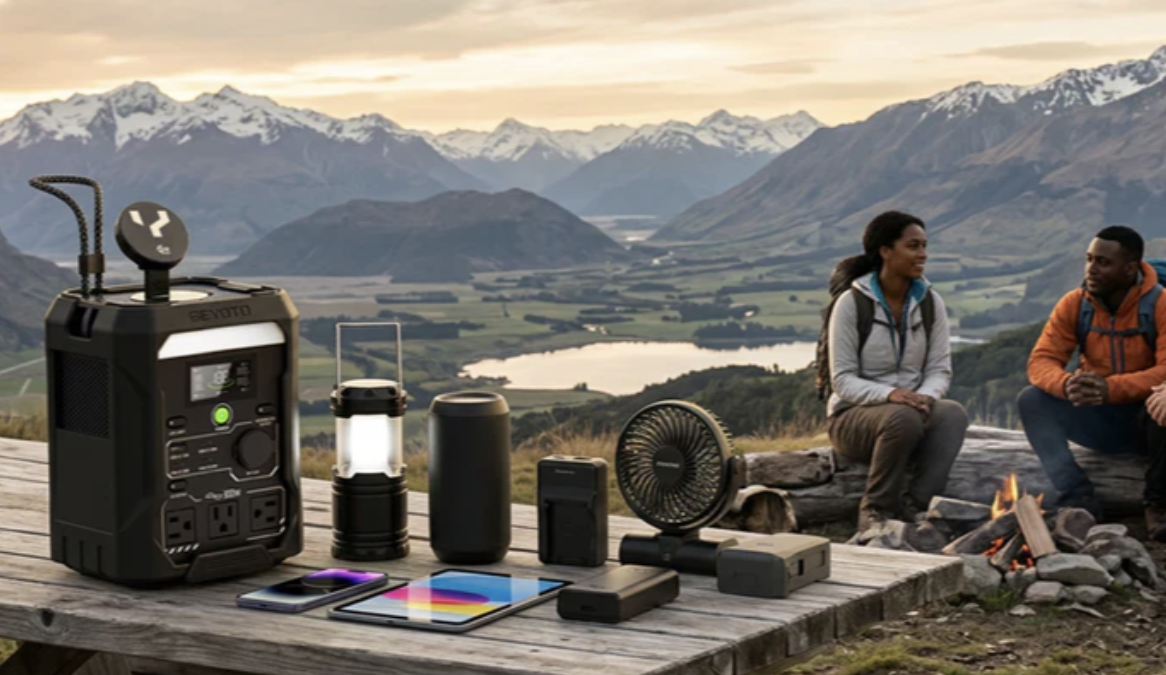
Furthermore, the physical footprint of the unit strikes an optimized mathematical balance between structural utility and convenient mobility. Weighing only 7.72 pounds, the system incorporates an ergonomic integrated handle to reduce hand fatigue during transport across long distances. This agile design allows first-time buyers to deploy reliable 300W pure sine wave power smoothly across diverse settings, ranging from backyard family gatherings to isolated lakeside fishing docks. By providing a comprehensive 9-port simultaneous output configuration, including a high-speed 65W USB-C port, the platform satisfies standard personal charging requirements without creating confusing configuration challenges.
Intelligent Power Management: Wi-Fi and Bluetooth Dual App Ecosystems
Modern consumer expectations demand seamless connectivity and effortless remote operation from off-grid electrical hardware. Traditional power units restrict users to physical buttons on the device chassis, which forces individuals to check energy statistics manually in uncomfortable weather conditions. To break down these operational barriers, GEYOTO (GEYOTO Technology Limited) integrates a sophisticated dual-protocol wireless application environment into its core product matrix. The system utilizes both Wi-Fi and Bluetooth connectivity to establish a robust, low-latency control loop with a paired smartphone.
This smart ecosystem enables users to audit system health, track real-time thermals, and toggle individual output ports from a distance. For instance, a camper resting inside a tent can easily deactivate external charging ports to save energy without stepping into the cold night air. Meanwhile, the intelligent app handles communication transitions automatically, shifting from Wi-Fi to Bluetooth protocols when the user moves beyond localized home router networks. This automated flexibility eliminates typical connection drops and provides beginners with a straightforward, worry-free management experience.
Buying With Confidence: What GEYOTO's Support System Means for You
For a first-time buyer, knowing what happens after the purchase matters just as much as the product itself. GEYOTO makes that part simple. The brand provides an extensive FAQ library that answers common questions across real-life scenarios — from powering a CPAP machine during a blackout to keeping a camping setup running through the weekend. This means you can find clear, honest answers before you buy, not just a sales pitch. Once your unit arrives, registering your device takes only a few minutes and unlocks an extended 5-year warranty, giving you years of coverage that most consumer electronics simply do not offer. If something ever goes wrong, you deal directly with the people who built it — no bouncing between third parties, no confusing return processes. For a beginner making their first off-grid purchase, that straightforward support structure makes a real difference.
Conclusion
Entering the portable power marketplace does not require a comprehensive degree in electrical engineering if consumers focus on fundamental performance metrics. By understanding the distinction between storage volume and output speed, avoiding surge traps, and choosing durable LiFePO4 chemistry, beginners can make secure investments. Sophisticated systems eliminate traditional user frustration through intelligent software integration, clear visual feedback, and multi-layered hardware safety networks. Ultimately, choosing a well-engineered unit transforms off-grid energy management into a natural extension of modern lifestyle comfort, ensuring safety and connectivity across any environment. Learn more about premium entry-level power solutions and explore detailed operational guides at the official corporate hub: https://www.geyoto.com/.
GEYOTO Technology Limited
GEYOTO Technology Limited
+1 213-292-9187
email us here
Visit us on social media:
Instagram
Facebook
YouTube
TikTok
Legal Disclaimer:
EIN Presswire provides this news content "as is" without warranty of any kind. We do not accept any responsibility or liability for the accuracy, content, images, videos, licenses, completeness, legality, or reliability of the information contained in this article. If you have any complaints or copyright issues related to this article, kindly contact the author above.
